
By Advanceline Editorial · 20 November 2026 · Conceptual illustration
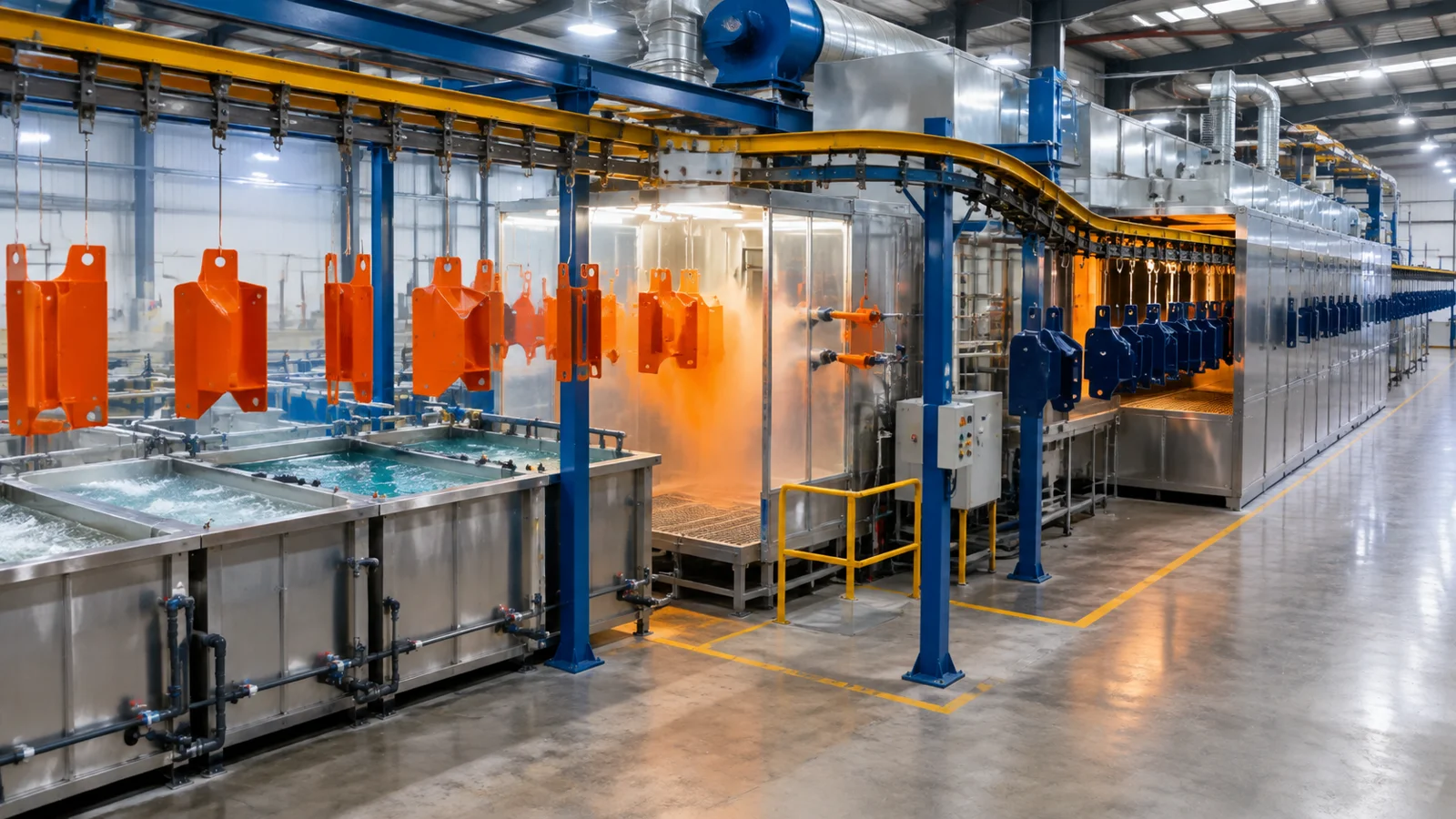
A successful powder-coated surface is the outcome of a sequence. Preparation, masking, grounded application, curing and cooling each create the conditions for the next stage. A weakness early in the process may not be obvious until the component reaches inspection.
1. Pre-treatment
The substrate must be cleaned and prepared for the coating system. The suitable treatment depends on the metal, existing contamination and service environment. Chemical selection, concentration and handling require an approved process and trained personnel.
2. Masking and hanging
Mask areas that must remain free of coating. Select fixtures that support the component securely while preserving the required grounding path. Loading position also affects access for spraying, drainage after preparation and the way heat reaches the part.
3. Electrostatic powder spraying
The hopper and delivery system feed powder to the gun. Charged particles are attracted toward the grounded component. Adjust the process to geometry rather than assuming one voltage or powder output is right for every part. Recesses and edges need particular attention.
4. Curing and baking
The coated component enters the curing oven. The process guide gives 180–200°C and 15–20 minutes as an illustrative process reference. This is not a universal recipe. The powder supplier’s specified metal temperature and time must govern the validated cycle. Part mass and loading arrangement affect heat-up.
5. Cooling and packing
Allow the component to cool before handling or packing. Inspect the finish using the requirements agreed for the application. Packing materials and contact points should protect the coating from damage during subsequent movement.
Connecting equipment stages
A complete process may be arranged for batches or continuous movement. The process explanation does not imply that every plant configuration is a listed product. Equipment should be chosen for the actual workload, floor layout and utility availability.
Process discipline
Keep records of preparation checks, grounding, application settings and cure validation. Investigate variation systematically rather than compensating at one stage for a problem at another. Clean, dry compressed air and correct earthing remain important fundamentals.
Frequently asked questions
Can preparation be skipped? Surface preparation is essential to an appropriate coating process. Is the example curing time always valid? No; use the powder technical data sheet. Should parts be packed hot? Establish a safe cooling and handling procedure appropriate to the finish.